
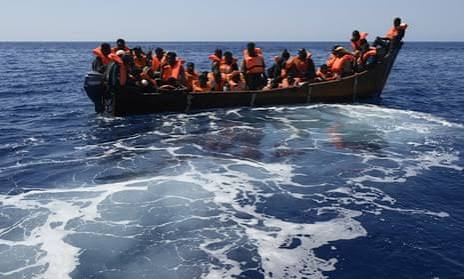
Fewer Migrants Are Reaching Europe by Sea — But the Journey Is Becoming Deadlier
Fewer migrants and refugees are reaching Europe by sea this year, but those attempting the journey are facing an increasingly deadly route.
New figures from the International Organization for Migration show that roughly 60,000 people have arrived in Europe by sea so far in 2026, compared with approximately 98,000 during the equivalent period of 2025.
That represents a decline of around 39%.
Yet the number of people reported dead or missing has moved in the opposite direction.
At least 2,292 people have died or disappeared during the journeys so far this year, compared with 1,999 over the same period last year, according to the UN migration agency.
The figures reveal an uncomfortable reality behind Europe's migration numbers.
Lower arrivals do not necessarily mean safer migration.
A Smaller Flow With a Higher Human Cost
Migration statistics are often discussed primarily in terms of how many people reach a country's borders.
Those numbers tell only part of the story.
For people attempting Mediterranean crossings, the difference between arrival and disappearance can depend on weather, the condition of a vessel, access to rescue services and the decisions of smugglers.
Many journeys take place aboard overcrowded or unseaworthy boats.
The IOM cautions that the actual number of deaths may be higher than the documented total because some boats can disappear without authorities ever receiving a complete record of who was aboard.
That makes migration at sea particularly difficult to measure.
An arrival can be counted.
A disappearance far from shore may never be fully documented.
Why People Continue Taking the Risk
The danger raises an obvious question.
Why would anyone board an unsafe vessel knowing that the journey could end at sea?
There is rarely one answer.
People attempting irregular migration routes can be escaping conflict, political instability, persecution or extreme economic hardship. Others may be searching for employment or attempting to reunite with family members.
For some, the decision develops after months or years of displacement.
Migration networks and smugglers can also present the journey as more manageable than it really is.
Once people have already travelled across several countries and invested their savings in reaching a departure point, turning back can become psychologically and financially difficult.
The result is a system in which enormous risks do not necessarily eliminate demand.
Libya Remains an Important Departure Point
Libya continues to play a central role in Mediterranean migration.
Its location places the North African country relatively close to southern Europe, while years of political instability have allowed smuggling networks to operate.
Migrants can spend long periods travelling across Africa before reaching Libya.
The final sea crossing may therefore represent only one part of a much longer journey.
By the time passengers reach the Mediterranean, some have already experienced exploitation, violence or detention.
They can then be placed on vessels poorly suited to crossing open water.
The danger is not simply distance.
A boat carrying too many passengers can become unstable. Engine failure can leave people stranded. Changing weather can transform a difficult journey into an emergency.
A 39% Decline Does Not End Europe's Migration Debate
Politically, the fall in arrivals could appear significant.
Irregular migration has become one of Europe's most contentious issues, influencing national elections, border policies and debates over the responsibilities of individual EU countries.
But falling numbers have not removed political pressure for tighter controls.
European governments continue debating how asylum claims should be processed, where migrants should be accommodated and whether people denied permission to remain can be transferred to countries outside the European Union.
The EU agreed in June on new rules allowing deportations outside the bloc under certain arrangements, Reuters reported.
Migration therefore remains politically important even when arrival numbers decline.
The Central Question Is About Safe Routes
The IOM argues that governments should expand opportunities for people to enter through legal channels while adopting policies that reduce the dangers faced along migration routes.
The reasoning is straightforward.
If people believe they have no realistic legal route, some may continue turning to smugglers regardless of how dangerous the journey becomes.
Legal pathways do not eliminate every form of irregular migration.
But they can provide alternatives for people who qualify for migration, protection, work or family reunification.
Critics of expanding legal routes may argue that governments must first maintain control over borders and ensure immigration systems are not overwhelmed.
That tension sits at the centre of Europe's migration debate: how to maintain border control while meeting humanitarian and legal responsibilities.
Numbers Can Hide Individual Lives
Migration statistics can become enormous very quickly.
Sixty thousand arrivals.
Thousands missing or dead.
Tens of thousands fewer crossings.
Percentages make trends easier to understand, but they can also make the issue feel abstract.
Each unsuccessful journey represents individuals who may have parents, children, partners or friends waiting for news.
For relatives, someone officially classified as "missing" can mean months or years without knowing whether that person died or survived somewhere else.
Identification is another challenge when bodies are recovered without documents.
The consequences therefore extend well beyond the moment a vessel disappears.
Search and Rescue Remains Contentious
Rescue operations in the Mediterranean have long been politically sensitive.
Coast guards, government vessels, commercial ships and humanitarian organisations can all encounter boats in distress.
Supporters of humanitarian rescue operations argue that protecting human life at sea must remain the immediate priority.
Some critics contend that rescue activity close to departure routes can unintentionally encourage smugglers to place migrants in unsuitable boats with the expectation that they will eventually be rescued.
The wider policy debate is complicated because saving somebody already in danger and preventing dangerous journeys from beginning are two different problems.
Governments must often address both simultaneously.
Climate and Instability Could Keep Migration Pressure High
Europe's migration challenge is unlikely to disappear simply because crossings have declined this year.
Conflict, economic instability and demographic pressures continue across several regions that have historically generated migration.
Climate-related pressures may increasingly interact with those factors.
Drought, extreme heat or changing agricultural conditions do not automatically cause international migration, but they can intensify existing economic and social pressures.
Migration patterns can therefore change quickly.
A route that becomes less active one year may increase again when political conditions shift elsewhere.
A Different Way to Measure Progress
The 2026 figures raise a broader question about how migration policy success should be measured.
If fewer people arrive but more people die attempting the journey, declining arrival numbers alone cannot describe the entire outcome.
Border management matters.
So does human safety.
A sustainable migration system ultimately has to consider both.
The latest figures show approximately 60,000 sea arrivals compared with 98,000 at the same stage last year, while documented deaths and disappearances have risen to at least 2,292.
Those two trends need to be understood together.
Europe's migration routes may be carrying fewer people in 2026.
For those who still attempt them, however, the journey has become more dangerous.